


本项目是一套面向计算机视觉应用的智能动物图像识别系统,旨在利用深度学习技术完成从数据采集、模型训练、特征可视化到图形界面交互的完整流程。系统以卷积神经网络为核心识别模型,结合Python生态中的多种开源工具,实现动物图片的自动获取、图像预处理、模型训练、性能评估、特征图可视化以及桌面端图形界面展示。通过该系统,用户不仅可以完成动物图像分类任务,还能够直观观察卷积神经网络在训练过程中学到的特征表示,从而更深入地理解深度学习模型在图像识别中的工作机制。
随着人工智能和计算机视觉技术的快速发展,图像识别已成为智能安防、智慧农业、生态保护、自然教育、野生动物监测等领域的重要技术手段。动物图像识别作为图像分类任务中的典型应用,具有较强的现实意义。例如,在野生动物保护中,系统可以辅助研究人员对拍摄到的动物照片进行快速分类;在自然科普教育中,系统可以帮助用户识别不同动物种类;在智能相册管理中,系统也可以用于自动整理动物相关图片。因此,构建一个结构完整、功能清晰、可交互的动物图像识别系统,不仅能够体现深度学习技术的实际应用价值,也具有较好的工程实践意义。
本系统的核心目标是通过卷积神经网络实现对多种动物图像的自动识别。卷积神经网络是一种专门用于处理图像数据的深度学习模型,其通过卷积层、池化层、激活函数和全连接层等结构,能够自动提取图像中的边缘、纹理、形状以及更高层的语义特征。与传统的图像识别方法相比,卷积神经网络不需要人工设计复杂的特征算子,而是通过大量数据训练自动学习图像表示,因此在图像分类任务中具有更强的适应性和更高的识别准确率。
在数据采集方面,系统使用Python的requests库从互联网上获取动物图片,构建用于模型训练和测试的数据集。requests库能够发送HTTP请求并获取网页返回的图像资源,配合文件保存和异常处理机制,可以实现对指定动物类别图片的批量下载。采集到的原始图片通常存在尺寸不一、格式不同、背景复杂、噪声干扰等问题,因此系统会对图片进行统一预处理。预处理过程包括图像尺寸归一化、格式转换、像素值归一化以及标签整理等步骤,使所有输入数据满足卷积神经网络的训练要求。通过自动化数据采集和预处理流程,系统能够在一定程度上减少人工整理数据集的成本,提高模型开发效率。
在模型训练方面,系统基于TensorFlow和Keras框架构建卷积神经网络模型。TensorFlow提供了强大的张量计算和自动微分能力,Keras则提供了简洁易用的模型构建接口,二者结合可以快速搭建深度学习模型。系统设计的CNN模型通常由多个卷积模块组成,每个模块包含卷积层、激活层和池化层。卷积层负责提取图像局部特征,激活层引入非线性表达能力,池化层则用于降低特征图维度并增强模型的平移不变性。在网络末端,系统通过全连接层和Softmax输出层完成动物类别的概率预测。训练过程中,系统使用交叉熵损失函数和梯度下降优化算法,不断调整网络参数,使模型能够更好地区分不同动物类别。
为了提升模型性能,系统还会对训练过程进行监控和调优。例如,通过设置合适的学习率、批量大小和训练轮数,可以在训练速度和模型准确率之间取得平衡;通过划分训练集、验证集和测试集,可以评估模型在未见数据上的泛化能力;通过记录训练损失和准确率变化曲线,可以判断模型是否存在过拟合或欠拟合现象。如果模型在训练集上表现良好但在验证集上表现较差,则说明模型可能过度记忆训练数据,此时可以通过数据增强、正则化、Dropout等方法进行改进。数据增强技术包括随机旋转、随机裁剪、水平翻转、亮度调整等,能够增加样本多样性,提高模型鲁棒性。
本系统的另一项重要功能是模型特征可视化。深度学习模型通常被称为“黑箱”,因为其内部特征提取过程不易直观理解。为了增强模型可解释性,系统使用Matplotlib绘制Keras模型的中间层特征图。当一张动物图片输入网络后,不同卷积层会输出不同的特征响应。浅层卷积通常关注边缘、颜色和基本纹理,中层卷积能够识别局部形状和结构,深层卷积则倾向于捕捉更抽象的语义信息。通过可视化这些中间层输出,用户可以观察模型在不同阶段关注到的图像区域,从而理解卷积神经网络是如何逐步从像素信息中提取高级特征的。这种可视化方式不仅有助于调试模型,也有助于教学和展示。
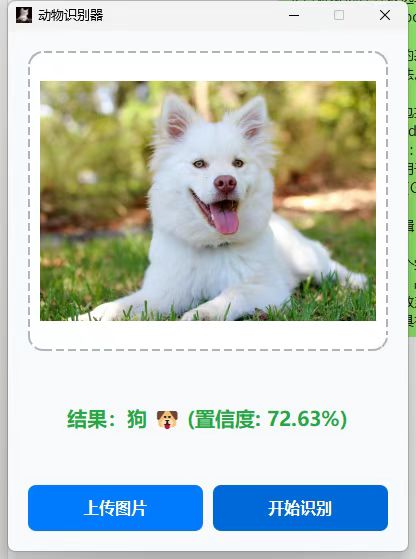
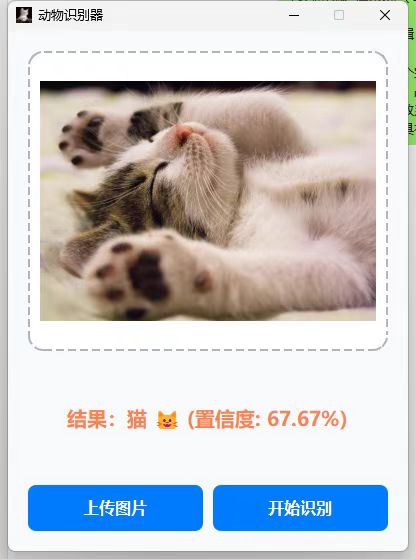
在交互体验方面,系统采用PyQt5开发图形化用户界面,为用户提供直观的操作入口。与命令行程序相比,图形界面更符合普通用户的使用习惯。用户可以在界面中选择本地动物图片,点击识别按钮后查看系统给出的预测类别及置信度。同时,界面也可以展示训练过程中的准确率曲线、损失曲线以及特征可视化结果。通过PyQt5,系统能够将图像加载、模型推理、结果展示和可视化分析整合到同一个桌面应用中,形成完整的使用闭环。对于毕业设计或课程项目而言,这种从算法到界面的完整实现能够较好地体现软件工程与人工智能技术的结合。
本系统的技术栈主要包括Python、TensorFlow、Keras、requests、NumPy、Pillow、PyQt5和Matplotlib。其中,Python作为主要开发语言,具有生态丰富、开发效率高、适合科学计算和人工智能应用等优点;TensorFlow和Keras负责模型构建、训练和推理;requests用于网络图片采集;NumPy用于数值计算和数组处理;Pillow用于图像读取、缩放和格式转换;PyQt5用于桌面图形界面开发;Matplotlib用于绘制训练曲线和特征图。各模块之间分工明确,既保证了系统功能的完整性,也便于后续扩展和维护。
从系统架构来看,本项目可以分为数据采集模块、数据预处理模块、模型训练模块、模型评估模块、可视化模块和图形界面模块。数据采集模块负责从网络获取动物图片并保存为本地文件;数据预处理模块对图片进行清洗、缩放和标签映射;模型训练模块构建CNN网络并完成参数优化;模型评估模块通过测试集计算准确率、召回率等指标;可视化模块展示训练过程和中间层特征;图形界面模块则将上述功能封装为友好的交互界面。整个系统流程清晰,模块耦合度较低,有利于分阶段开发和功能迭代。
本项目的创新性和实践价值主要体现在三个方面。第一,系统实现了从数据获取到模型部署的端到端流程,而不是仅停留在模型训练阶段,具有较强的工程完整性。第二,系统加入了特征可视化功能,使深度学习模型的内部表示更加直观,有助于理解卷积神经网络的工作机制。第三,系统通过PyQt5提供图形界面,降低了用户使用门槛,使算法成果能够以更易用的方式呈现出来。对于计算机视觉、深度学习和Python应用开发的学习者而言,该项目能够综合训练数据处理、模型设计、可视化分析和界面开发等多方面能力。
未来,该系统还可以进一步扩展和完善。例如,可以引入更复杂的网络结构,如ResNet、MobileNet或EfficientNet,以提升识别准确率;可以增加更多动物类别,扩大数据集规模,提高模型泛化能力;可以加入实时摄像头识别功能,使系统能够对视频帧进行连续识别;也可以将模型部署为Web服务或移动端应用,进一步提升系统的可用性和实用性。总体而言,基于CNN卷积神经网络的动物图像识别系统不仅具有明确的应用场景,也能够体现深度学习技术在图像识别领域的典型开发流程,是一个兼具理论意义和工程实践价值的综合性项目。
Image recognition has become one of the most important application areas of deep learning. With the rapid development of convolutional neural networks, computer vision systems are now able to classify objects, detect regions of interest, and recognize complex patterns in images with high accuracy. Among various image classification tasks, animal image recognition is particularly representative because animal images often contain diverse poses, complex backgrounds, varying lighting conditions, and large intra-class differences. Therefore, building an intelligent animal image recognition system based on convolutional neural networks not only has practical value in ecological monitoring, wildlife protection, intelligent education, and image management, but also serves as a typical case for studying deep learning-based visual recognition methods.
Early image recognition methods mainly relied on handcrafted features. Traditional approaches such as SIFT, HOG, and LBP were widely used to extract texture, edge, and shape information from images. These features were then fed into classifiers such as support vector machines or k-nearest neighbors for image classification. Although such methods achieved certain success in simple scenarios, they often required careful feature engineering and were sensitive to changes in illumination, scale, rotation, and background. When applied to animal images, traditional methods struggled to handle the large variation in animal appearance, posture, and environment. As a result, their generalization ability was limited, especially when the number of animal categories increased.
The development of deep learning has significantly changed the field of image recognition. Unlike traditional methods, deep learning models can automatically learn hierarchical feature representations from raw pixel data. Convolutional neural networks are especially suitable for image tasks because they exploit the spatial structure of images through local receptive fields, shared weights, and pooling operations. A typical CNN consists of several convolutional layers, activation functions, pooling layers, and fully connected layers. Convolutional layers extract local features such as edges and textures, pooling layers reduce spatial dimensions and improve translation invariance, and fully connected layers combine these features for final classification. This end-to-end learning mechanism allows CNNs to achieve much higher performance than traditional feature-based methods on large-scale image datasets.
A major milestone in the development of CNNs was the success of AlexNet in the ImageNet Large Scale Visual Recognition Challenge. AlexNet demonstrated that deep convolutional neural networks could significantly outperform traditional methods when trained on large-scale labeled datasets using GPU acceleration. After AlexNet, many improved network architectures were proposed. VGGNet showed that increasing network depth with small convolution kernels could improve recognition performance. GoogLeNet introduced the inception module, which allowed the network to capture features at multiple scales while controlling computational cost. ResNet introduced residual connections, making it possible to train very deep networks without suffering from severe gradient degradation. These architectures have greatly advanced image classification and have been widely used in many computer vision applications.
In the field of animal image recognition, CNN-based methods have also shown strong performance. Animal classification is more challenging than general object classification in some cases because animals of the same species may appear very different due to age, posture, fur color, or habitat. At the same time, different species may look similar, especially when only part of the body is visible. Many studies have used publicly available animal datasets to train and evaluate CNN models. Some works focus on fine-grained animal classification, where the differences between categories are subtle. Others apply transfer learning to improve recognition accuracy when the available dataset is relatively small. Transfer learning allows a model pre-trained on a large dataset such as ImageNet to be fine-tuned for a specific animal classification task, which often leads to faster convergence and better performance.
Data quality and data augmentation also play important roles in animal image recognition. Deep learning models usually require a large amount of labeled data. However, collecting and annotating animal images can be time-consuming and expensive. In practice, many systems use web crawling techniques to collect images from the Internet. Python libraries such as requests can be used to send HTTP requests and download images according to keywords or category labels. Although this method can quickly expand the dataset, the collected images often contain noise, duplicates, irrelevant content, or inconsistent resolutions. Therefore, data cleaning, format conversion, resizing, and label verification are necessary before training. Data augmentation methods such as random rotation, horizontal flipping, random cropping, brightness adjustment, and scaling can further increase sample diversity and help the model become more robust to real-world variations.
Model training and evaluation are central parts of any animal image recognition system. TensorFlow and Keras are widely used frameworks for building and training CNN models. Keras provides a high-level interface that simplifies model construction, while TensorFlow provides efficient computation and optimization capabilities. During training, the model parameters are updated by minimizing a loss function, usually categorical cross-entropy for multi-class classification. The optimization algorithm adjusts the weights based on gradients computed through backpropagation. Common evaluation metrics include accuracy, precision, recall, F1-score, and confusion matrix. Accuracy measures the overall proportion of correct predictions, while precision and recall provide more detailed information about the model’s performance on each class. The confusion matrix is especially useful for analyzing which animal categories are easily confused.
One important issue in deep learning is model interpretability. Although CNNs can achieve high recognition accuracy, their internal decision process is often difficult to understand. Feature visualization helps to address this problem by showing what different layers of the network have learned. Shallow convolutional layers usually respond to low-level features such as edges, colors, and simple textures. Middle layers tend to capture local patterns such as eyes, ears, fur texture, or body contours. Deeper layers represent more abstract semantic information related to specific animal categories. By visualizing intermediate feature maps using tools such as Matplotlib, developers and users can better understand how the network processes an input image step by step. This not only supports model debugging but also improves the educational value of the system.
Another important aspect of practical system development is user interaction. Many deep learning projects remain at the algorithm level and lack a friendly user interface. However, for an animal image recognition system to be useful in real applications, it should provide an intuitive way for users to upload images, view recognition results, and explore model behavior. PyQt5 is a powerful Python library for developing desktop graphical user interfaces. With PyQt5, the system can integrate image loading, model prediction, result display, training visualization, and feature map visualization into a single application. Users do not need to run command-line scripts or modify code to use the system. This improves usability and makes the system more suitable for demonstration, teaching, and practical deployment.
Despite the progress made by CNN-based animal image recognition systems, several challenges still exist. First, the performance of the model depends heavily on the quality and diversity of the dataset. If the collected images are biased, noisy, or insufficient, the model may not generalize well. Second, some animal categories are visually similar, which makes fine-grained classification difficult. Third, real-world animal images may contain occlusion, motion blur, complex backgrounds, and varying viewpoints, all of which can reduce recognition accuracy. Fourth, deep neural networks usually require considerable computational resources, which may limit their deployment on low-end devices. Finally, model interpretability remains an open problem. Although feature visualization provides some insight, it does not fully explain why the model makes a particular decision.
To address these challenges, future work can be conducted in several directions. One direction is to adopt more advanced network architectures such as ResNet, MobileNet, or EfficientNet to improve recognition accuracy and efficiency. Another direction is to use transfer learning and data augmentation to enhance model performance when labeled data are limited. Real-time recognition can also be explored by applying the trained model to video streams or camera inputs. In addition, the system can be extended to support web deployment or mobile deployment, allowing more users to access it without installing complex development environments. Explainable AI methods may also be introduced to provide more reliable explanations for model predictions.
In summary, animal image recognition based on convolutional neural networks is a representative application of deep learning in computer vision. Existing research shows that CNNs can automatically learn effective feature representations and achieve high classification accuracy. However, practical systems still need to consider data collection, preprocessing, model training, evaluation, visualization, and user interaction as a complete pipeline. The system proposed in this project integrates web image crawling, CNN model training, feature map visualization, and a PyQt5-based graphical interface. It not only realizes the core function of animal image recognition, but also provides visual analysis tools to help users understand the internal behavior of the model. This makes the system suitable for academic research, graduation projects, and introductory exploration of deep learning-based image recognition.
转载自 CSDN-专业IT技术社区
原文链接:https://blog.csdn.net/weixin_70367240/article/details/167812262